By Vuyokazi Yokwe, NACOSA Legal Officer
As Child Protection Month closes, the question is not only whether children are protected, but whether the village itself remains capable of protection.
There is an African proverb that it takes a village to raise a child. It is a proverb so deeply embedded in social justice discourse, constitutional thought, policy frameworks, and community organising that it is often repeated without interrogation. Yet few pause to ask whether the village itself has remained intact enough, or human enough, to raise a child.
The proverb has travelled widely through treaties, legislation, policy frameworks, and institutional commitments. It has shaped the imagination of civil society and informed the entry point of many into the social justice sector, grounded in the belief that law, dignity, and collective responsibility can reshape lived reality. And yet, across contexts, children continue to grow up in conditions of violence, deprivation, exploitation, and structural abandonment. The village, in practice, is fractured.
The Constitutional Village
Within the Constitutional village of South Africa, a foundational ethic of care is intended to anchor the protection of children. Section 28 provides that the best interests of the child are paramount. Legislative and policy frameworks exist, including mandatory reporting mechanisms. The High Courts remain the upper guardian of all children. The Constitutional order continues to echo a foundational reminder attributed to Nelson Mandela: “The true character of a society is revealed in how it treats its children.”
Despite Constitutional supremacy, extensive legislative frameworks, and well-developed policy architecture, children continue to inhabit environments where protection is inconsistently realised. This contradiction is also reflected in national reporting and shared institutional concern. Government reporting during Child Protection Month 2026 records 8,984 cases of child abuse in the 2025/26 period, including 3,258 cases of sexual abuse. These figures underscore the continued urgency of the national theme of “working together in ending violence against children”, and reflect a shared responsibility across government, civil society, and communities to strengthen prevention, reporting systems, case management, and psychosocial support.
Yet the lived journey of a child in this village is increasingly defined by the absence of protection.
A fractured protective architecture
The child protection framework imagines a child at the centre of layered systems of care: family, community, schools, health services, social development systems, and institutional safeguards. In theory, each layer reinforces the next. In practice, these layers are uneven, weakened, and in many instances fractured simultaneously.
Children navigate environments where safety is not guaranteed. Movement to and from school, access to basic services, and participation in public life may expose them to violence shaped by poverty, inequality, and social exclusion. For some children, visibility itself becomes risk; a gay child in Khayelitsha is not only a constitutional subject but a body negotiating survival in a space where recognition has failed to translate into protection. The 2025 killing of 16-year-old Kwakhanya Mhlanganisi in Khayelitsha, widely reported as a suspected hate crime, stands as a stark reminder that vulnerability is not abstract but located, lived, and potentially fatal.
The violence is not only external. It is also domestic, institutional, and spatial, unfolding across homes, schools, and communities that ought to constitute protection.
These realities are further intensified where violence intersects with HIV vulnerability. Poverty, instability, school dropout, stigma, and limited access to services interact to produce layered risk. HIV vulnerability cannot be separated from violence, just as child protection cannot be separated from inequality. The result is a fragmented village in which multiple vulnerabilities accumulate at once.
Mapping the fragmented village
This fragmentation is not abstract. It is geographically mapped across implementation sites where interventions are required most urgently. Vulnerability is therefore not only conceptual; it is spatially located within specific communities, districts, and service environments.
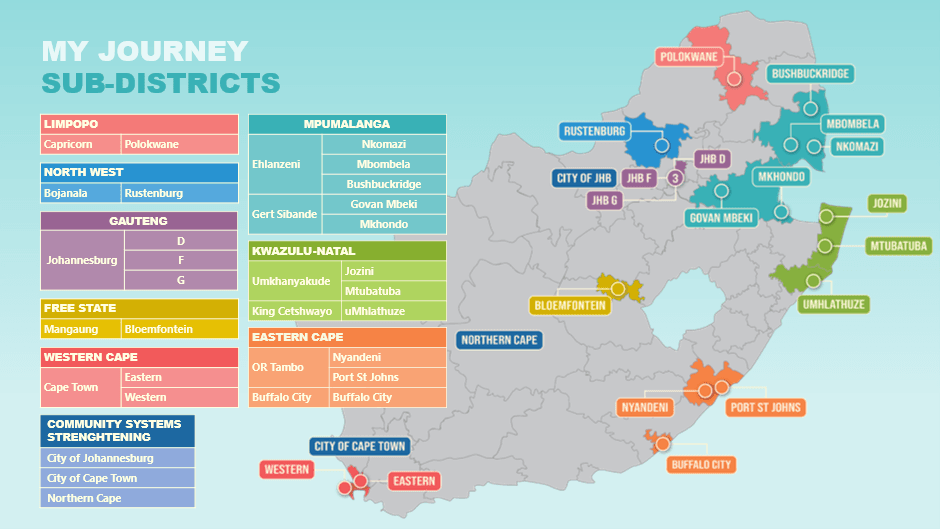
Implementation sites of NACOSA’s My Journey programme
The village is therefore not only metaphorical, but spatially distributed, with vulnerability and intervention occupying the same terrain
Rebuilding fractured layers
Within this reality, the My Journey programme implemented by NACOSA, targeting adolescent girls and young women and funded by the Global Fund, reflects a programmatic intentionality to rebuild fractured layers surrounding the child. It advances human rights-centred interventions through legal literacy, sensitisation, community dialogue, referral pathways, safe spaces, and layered systems of support.
Its significance lies not only in service delivery, but in the reconstruction of protective ecosystems within communities where vulnerability is socially and spatially produced. Dialogue becomes intervention. Community engagement becomes part of protection. Legal literacy becomes a tool for survival and agency.
The programme contributes to reducing new HIV infections, improving health outcomes, addressing human rights-related barriers to services, and strengthening prevention systems. Yet its deeper value lies in what it attempts to restore: fragments of a village capable of recognising and protecting children in their full humanity.
Beyond the green ribbon
As the green ribbon is put back into the drawer at the close of Child Protection Month, the question is not only how children are protected from violence, but whether the conditions that produce that violence are being meaningfully confronted.
A child cannot flourish in a village organised around fear, cannot dream where hunger is structural, and cannot heal where violence has been normalised into everyday life. Neither can a constitutional democracy continue to claim moral legitimacy while children navigate danger as a condition of ordinary existence.
Beyond the ribbon lies a harder obligation: the rebuilding of the village itself.