
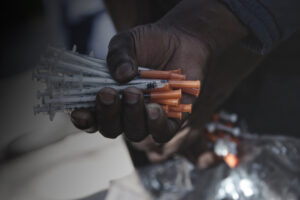
Needle and Syringe Programmes
South Africa needs a national policy framework to support Needle and Syringe Programmes (NSPs) as part of its response to HIV, hepatitis C and other blood-borne infections among people who

In South Africa, all women face a disproportionate HIV burden, but the disparity is most pronounced among adolescent girls and young women between 15 and 24 years, whose HIV prevalence is over three times greater than their male peers. My Journey is a national programme, built on youth programmes funded by the Global Fund since 2016, to help address this disparity and reduce the incidence of HIV by providing choice and agency to young women and girls.
The HERStory 3 study commissioned by the Global Fund principal recipients (NACOSA, AFSA and Beyond Zero), was conducted by the South African Medical Research Council to evaluate the impact of the My Journey Programme, investigating HIV prevalence andincidence, knowledge of HIV status, school retention and HIV prevention and care coverage. According to the SAMRC:
“It is rare to evaluate combination HIV prevention interventions on such a large scale and this evaluation is one of the few that have been conducted. Such large-scale evaluations are critical as they provide vital information on how well the combination HIV prevention intervention strategies might work for countries with large HIV epidemics.”
My Journey was a combination HIV prevention intervention for adolescent girls and young women implemented in 12 subdistricts across eight provinces of South Africa. It aimed to reduce HIV incidence, teenage pregnancy, and gender-based violence and increase retention in school and access to economic opportunities. It was funded by the Global Fund to Fight AIDS, Tuberculosis and Malaria and implemented by South African organisations, including NACOSA.
The evaluation was a non-randomised cluster controlled trial conducted in 12 intervention and 12 matching comparison subdistricts. Two sites per subdistrict were sampled with 100 young women aged 15-24 years enrolled per site, providing a sample size of 4,800 young women. Dried blood spot specimens were taken to measure HIV status (as the primary outcome of the evaluation) and exposure to antiretrovirals, pre-exposure prophylaxis (PrEP) and viral load level. Participants self-completed an electronic questionnaire and an optional HIV rapid test was offered to participants after survey completion. A qualitative component of the study looked at the acceptability of the intervention with young women as well as the self-reported impact the programme had on their lives.
The young women that took part in the study faced a number of challenges. Rates of maternal orphanhood were high (over 15%) and the rates of paternal orphanhood were even higher (over 24%) in both the intervention and comparison communities. Approximately one third of all participants reported that they had ever been pregnant. Among participants under 20, 17% in the intervention arm and 15% in the comparison arm had ever been pregnant.
My Journey reached a large proportion of participants in the targeted sites – between 21% and 73% of participants reported being approached by one of the implementers and invited to participate in the programme. Most participants reported that the first time they were approached was at home (29%), at school (26%) or at a clinic (4%). Most participants reported to have received good quality service, were treated in a friendly and respectful manner, waited no longer than one hour, and were provided a confidential and comprehensive service. Over 78% in all subdistricts reported “good” or “wonderful” experiences of the programme.
“I felt like that there are people out there that care, I felt cared for, that there are people that take effort for me.” – qualitative study participant
HERStory3 found a statistically significant impact on increasing knowledge of HIV status – with 85% of young women in the intervention arm and 81% in the comparison arm knowing their HIV status. There was reliable evidence that HIV testing of all kinds was statistically significantly higher in the intervention arm. HIV self-testing was significantly higher in the intervention arm compared with the comparison arm.
My Journey made a small impact on reducing HIV prevalence. HIV prevalence was 9.5% in the intervention arm and 10.4% in the comparison arm with a risk difference of 0.9%, after adjusting for age, socio-economic status, education enrolment, sexual debut and maternal orphanhood. The study was powered to detect a decrease in HIV prevalence from 12% to 6%: four subdistricts (Klipfontein, Dihlabeng, Fetakgomo Tubatse and Rusternburg) met or exceeded the expected 6% difference, five subdistricts (Abaqulusi, Govan Mbeki, Setsoto, Tswane 1 and City of Uhlathuze) showed a decrease from the expected baseline prevalence of 12% but not reaching 6%, and three subdistrict (Nelson Mandela, Nyandeni and Mbombela) showed no positive intervention effect.
The My Journey Programme substantially increased the coverage of PrEP among young women who were not living with HIV, doubling the uptake of PrEP in the intervention arm compared with the comparison arm. The HIV prevention cascades for PrEP show substantial and statistically significant differences in favour of the intervention arm in knowing what PrEP is, ever having been offered PrEP, and ever having used PrEP.
Key recommendations on increasing the uptake and sustained use of PrEP included:
In the qualitative study, those young women who were using PrEP, reported a sense of feeling happy, protected and safe – in a context of high HIV prevalence and sexual violence – leading to a strong motivation to continue using it.
A concerning finding from the study was that under 75% of HIV positive girls and young women in both arms were virally suppressed. Maintaining an undetectable viral load is important for the health of people living with HIV and is one of the most effective ways of preventing onward HIV transmission as an undetectable viral load means that the virus cannot be transmitted (undetectable equals untransmissible or U=U). These findings will inform My Journey Programme strategies to ensure better care and support for young women living with HIV.
The study results suggest a positive intervention impact on some of the perceived access barriers to condoms and young women in the intervention arm were more likely to have accessed information and counselling about condoms. However, the evaluation produced no evidence to show that the My Journey Programme impacted the coverage of condoms overall.
“If you are using a condom they do not want you, they want people who are not using a condom.” – qualitative study participant
What seems to be most important to young women is quality of care, specifically the feeling of being respected and treated well by staff offering services. To ensure acceptability of services for young women, comprehensive services need to be provided in youth-friendly accessible spaces, by youth-friendly staff.
Key recommendations flowing from the research included:
The HERStory3 study – as well as programme data – provided a rich source of learning that influenced the development of the next phase of the My Journey programme which runs from 2025 to 2028 and will reach over 380,000 girls and young women. It will be the largest youth programme in South Africa, funded by the Global Fund through NACOSA and implemented in communities by local organisations.
Young women will receive services in a range of community locations including safe spaces, hot spots, secondary schools and institutions of higher learning and community spaces. Health services will be provided according to a young woman’s needs, prioritising HIV testing, consistent condom use, prevention choices and continuity of care. Services for young women are grouped into three themes of My Journey which covers assessment and enrolment, My Choice for core health services, and My Voice for human rights issues and referrals.
“For so many young women, we need that hope. We need someone to hold our hand and tell us that it’s going to be okay.” – Tsakane Maluleke
South Africa needs a national policy framework to support Needle and Syringe Programmes (NSPs) as part of its response to HIV, hepatitis C and other blood-borne infections among people who

NACOSA hosted the Amaqhawekazi Harm Reduction Summit 2026, from 26-27 August 2026, bringing together representatives of government departments, civil society organisations, community-led organisations, development partners, researchers, advocates, people who use

South Africa’s current drug policy framework is fragmented, with contradictions between legislation that criminalises personal drug use and policy commitments that recognise prevention, treatment, harm reductionand social reintegration as essential
A policy brief examining the legal and policy framework relating to under 18s who use drugs, including injecting drug use.